If you ask most business owners one simple question — “Is your business actually profitable?” — many won’t immediately know the answer.
Revenue might be increasing, sales may look strong, and customers keep coming in. But none of that tells the full story unless you look at a profit and loss statement (P&L statement).
A profit and loss statement is one of the most important financial reports for any business. It shows how much money a company earned, how much it spent, and whether the business ended the period with a profit or a loss.
In most companies, this report is generated as part of routine bookkeeping service processes. Bookkeepers track financial transactions, categorize expenses, and organize revenue data so reports like the P&L statement accurately reflect the company’s financial performance.
For business owners, investors, and accountants, this report becomes the starting point for understanding financial health.
Table of Contents
What Is a P&L Statement
Why the Profit and Loss Statement Matters
Profit and Loss Statement Format Explained
Profit and Loss Statement Example
Common Size Statement of Profit and Loss
Profit and Loss Statement vs Balance Sheet
How to Read a Profit and Loss Statement
Profit and Loss Excel Template vs Accounting Software
How Bookkeeping Services Support Financial Reporting
Frequently Asked Questions ( FAQs )
What Is a P&L Statement?
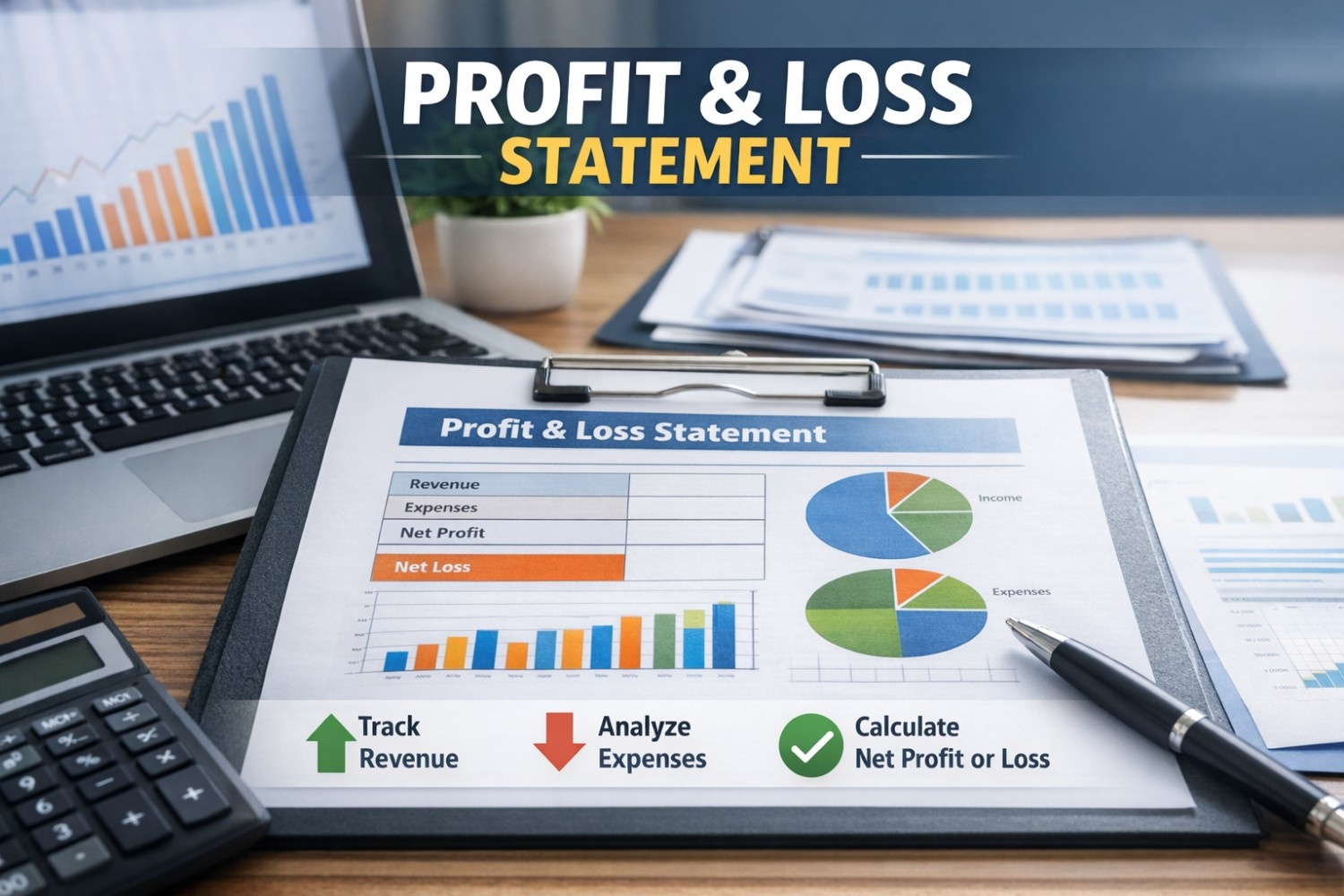
A P&L statement, also called a profit and loss statement, is a financial report that summarizes a company’s revenue, expenses, and profits over a specific time period.
Most businesses generate this report monthly, quarterly, or annually.
The goal is simple:
to clearly see whether the business is making money or losing money.
A typical P&L statement includes:
Revenue or sales
Cost of goods sold (COGS)
Operating expenses
Net profit or loss
Many growing businesses rely on bookkeeping services for small business to maintain clean financial records so reports like the P&L statement remain accurate and reliable.
Why the Profit and Loss Statement Matters
From an operational standpoint, the profit and loss statement is one of the most frequently reviewed financial reports.
It helps businesses answer important questions such as:
Are we profitable this month?
Which expenses are increasing?
Is revenue growing or declining?
Are operating costs too high?
While other reports like the profit and loss balance sheet show the financial position of a business at a moment in time, the P&L statement focuses on performance over a period.
For many business owners, reviewing this report regularly is one of the simplest ways to understand whether the company is financially healthy.
Profit and Loss Statement Format Explained
The profit and loss statement format typically follows a structured layout that makes financial analysis easier.
The basic sections usually include:
Revenue
This represents the total income generated by the business through sales or services.
Cost of Goods Sold (COGS)
These are the direct costs involved in producing goods or delivering services.
Gross Profit
This is calculated as:
Revenue – Cost of Goods Sold
Operating Expenses
Operating expenses may include:
Rent
Salaries
Marketing
Utilities
Software subscriptions
Net Profit or Loss
After subtracting all expenses, the final figure shows whether the business made a profit or incurred a loss.
Most modern bookkeeping computer programs automatically generate this report once financial transactions are recorded correctly.
Profit and Loss Statement Example
Here is a simplified profit and loss statement example for a small business.
Even in this basic example, the P&L statement quickly shows whether the company generated a profit.
Accurate financial reporting like this usually depends on reliable bookkeeping services for small business, which ensure that income and expenses are consistently tracked.
Common Size Statement of Profit and Loss
A common size statement of profit and loss presents financial data slightly differently.
Instead of listing only dollar amounts, each line item is expressed as a percentage of total revenue.
For example:
This format allows businesses to compare performance across different periods or benchmark against industry standards.
Profit and Loss Statement vs Balance Sheet
It’s common for business owners to confuse the profit and loss statement with the balance sheet.
However, the two reports serve different purposes.
Profit and Loss Statement
Shows revenue, expenses, and profit during a specific time period.
Balance Sheet
Shows assets, liabilities, and equity at a particular moment in time.
Both reports rely on financial data recorded through professional bookkeeping service processes.
How to Read a Profit and Loss Statement
Understanding how to read a profit and loss statement is essential for making informed business decisions.
When reviewing a P&L statement, focus on three key areas.
Revenue Trends
Look for consistent growth or sudden declines in revenue over time.
Expense Patterns
Identify operating expenses that are increasing faster than revenue.
Profit Margins
Strong profit margins often indicate efficient cost management and healthy operations.
Accurate reports generated through reliable bookkeeping computer programs make this analysis far easier.
Profit and Loss Excel Template vs Accounting Software
Some small businesses begin with a profit and loss Excel template to track financial performance.
While spreadsheets can work initially, they often become difficult to manage as the business grows.
That is why many companies transition to accounting software such as QuickBooks, which automates financial reporting and reduces manual errors.
Professional bookkeepers frequently combine accounting software with dedicated bookkeeping services to ensure financial data remains accurate and organized.
How Bookkeeping Services Support P&L Reporting
The profit and loss (P&L) statement is part of routine financial reporting within bookkeeping operations.
Bookkeepers record transactions, categorize expenses, reconcile accounts, and generate reports that business owners rely on for decision-making.
Profit and loss statements are therefore closely connected to bookkeeping services, since accurate financial records are required before these reports can be produced. Accountants later use the same reports for tax preparation and deeper financial analysis.
Businesses that use tools like QuickBooks often seek professional support to manage bookkeeping and maintain accurate financial reports.
If you need assistance with financial reporting, QuickBooks setup, or ongoing bookkeeping tasks, Quick Ledger Accounting provides dedicated support.
📞 Quick Ledger Help Desk
+1 (888) 927-9291
Frequently Asked Questions
What is a P&L statement?
A P&L statement is a financial report that summarizes revenue, expenses, and net profit or loss for a business over a specific period.
Is a profit and loss statement the same as an income statement?
Yes. The profit and loss statement is another term used for an income statement in accounting.
Can I create a profit and loss statement in Excel?
Yes. Many small businesses start with a profit and loss Excel template before transitioning to accounting software.
Who prepares profit and loss statements?
Profit and loss statements are typically prepared by accountants or professional bookkeeping service providers as part of routine financial reporting.
Ready to Get Your Books in Order?
Schedule a free consultation with our certified bookkeepers. We'll review your current financials and create a custom plan to streamline your accounting.
Book Free Consultation →